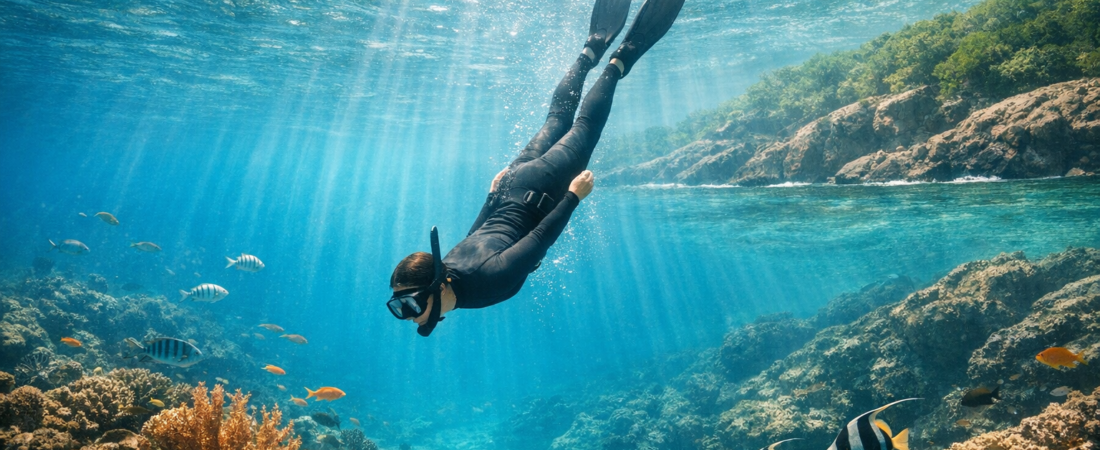
Thinking about trying freediving in India? Whether you’re drawn to the coral reefs of the Andaman Islands or the crystal lagoons of Lakshadweep, this beginner’s guide covers everything you need to start safely and confidently. From core skills like diaphragmatic breathing and Frenzel equalization to essential gear like long-blade fins and a low-volume mask, you’ll learn what matters most before your first descent. We also cover shallow water blackout safety, how to choose an AIDA or SSI course, and the best regions to freedive across India’s coastline.
What Is Freediving? Benefits Beyond Holding Your Breath
At its core, freediving is the art of exploring underwater on a single breath — no tanks, no regulators, just you and the ocean. Beginners often assume success depends on lung capacity, but experienced freedivers will tell you it’s predominantly about calm. The ability to slow your heart rate, manage oxygen consumption, and move with minimal effort is what separates a comfortable freediver from a struggling one.
Freediving in India offers something unique: warm waters, rich marine biodiversity, and a growing community of instructors and training centres from Pondicherry to the Andaman archipelago. It’s one of the most meditative and rewarding ways to connect with the sea — and it’s more accessible than you might think.
Core Skills for Beginner Freedivers (Breathing, Equalization, Streamlining, Apnea)
Every beginner freediving course in India will focus on these four foundational skills. Master them progressively and you’ll build comfort, control, and confidence underwater.
1. Breathe: Diaphragmatic Breathing
Before you ever enter the water, learn to breathe deeply using your diaphragm rather than your chest. This maximises oxygen intake during your breathe-up and activates your body’s relaxation response. Place one hand on your belly and one on your chest — the belly should rise first and most. Practice this daily until it becomes your default breathing pattern.
2. Equalize: The Frenzel Technique
As you descend, water pressure increases and compresses the air spaces in your ears and sinuses. The Frenzel equalization technique — using the tongue to push air into the Eustachian tubes — is the standard method freedivers use to equalize comfortably without wasting air. Practise this on dry land until it becomes second nature. With daily dry practice, many beginners achieve reliable Frenzel equalization within one to two weeks.
3. Streamline: Efficient Body Position
Efficient movement underwater conserves oxygen. Maintain a straight body line, relaxed neck, and slow, deliberate fin kicks. Think of yourself as gliding rather than swimming. Every unnecessary movement burns oxygen you cannot replace until you surface.
4. Practice: Static and Dynamic Apnea
Static apnea — breath-holding while stationary in a pool — builds your comfort with the breath-hold reflex and the urge to breathe. Dynamic apnea — swimming horizontally underwater — develops technique, fin efficiency, and real-world confidence. Both are practised extensively in any beginner freediving course in India.
Is Freediving Safe? Rules Every Beginner in India Must Know
Freediving is remarkably safe when practised responsibly, but it demands respect. Here are the non-negotiable safety rules every beginner must follow:
Never freedive alone. A trained buddy watching from the surface is your primary safety net. This is not a guideline — it is the cardinal rule of the sport.
Understand shallow water blackout. This is a loss of consciousness that can occur near the surface during ascent when oxygen levels drop critically. It happens without warning, which is precisely why a vigilant buddy system is essential, not optional. Shallow water blackout safety awareness should be your first priority before any open-water diving.
Never hyperventilate before a dive. While rapid breathing may feel like it extends your breath-hold, it actually suppresses your body’s natural urge to breathe, increasing blackout risk without meaningfully adding oxygen. Relaxed, controlled breathing is both safer and more effective.
Take a certified course. For structured learning, enrol in an AIDA or SSI course at a recognised centre. A proper beginner freediving course teaches rescue techniques, safety protocols, and correct progression — elements that no amount of self-study or YouTube videos can fully replace.
Ready to start freediving in India? Compare AIDA vs SSI beginner courses and choose your first class based on location, schedule, and instructor experience.
Essential Freediving Gear for Beginners in India
The beauty of freediving lies in its simplicity. Here’s your essential starter kit:
- Low-volume mask: Sits close to the face and requires less air to equalize at depth
- Snorkel: For comfortable surface breathing between dives
- Long-blade fins: Provide efficient propulsion with minimal leg effort — the single biggest upgrade from regular swim fins
- Wetsuit (2–3mm): Works well for most Indian waters year-round, providing thermal comfort and slight buoyancy
- Weight belt with quick-release buckle: Helps achieve neutral buoyancy at your target depth
- Dive buoy with flag: Signals your presence to boat traffic — essential in busy coastal areas
Start with quality basics rather than investing in advanced equipment. Your skills matter far more than your gear at this stage. A good mask that seals well and fins that fit comfortably will serve you better than expensive carbon blades you haven’t learned to use.
Unsure about gear? See our essential freediving gear checklist for Indian waters for specific product recommendations and sizing guidance.
Best Places to Freedive in India: Andaman, Lakshadweep, Goa, Pondicherry
India’s coastline and island territories offer diverse conditions for freedivers at every level. These four regions provide year-round opportunities and established diving infrastructure.
Andaman Freediving
The crown jewel of freediving in India. Havelock Island (Swaraj Dweep) and Neil Island (Shaheed Dweep) offer crystal-clear visibility often exceeding 20 metres, vibrant coral reefs, and calm conditions for much of the year. Multiple freediving schools operate here with AIDA and SSI-certified instructors. The warm water (27–30°C) and sheltered bays make it ideal for beginners, while deeper walls and channels offer progression for intermediate divers.
New to Andaman freediving? Find beginner-friendly sites around Havelock and Neil where calm conditions and excellent visibility make early dives comfortable and rewarding.
Lakshadweep Freediving
This remote archipelago boasts some of the clearest waters in the Indian Ocean — visibility can reach 30 metres or more. Shallow lagoons with sandy bottoms provide perfect training grounds for practising equalization and duck dives in controlled conditions. Outer reef walls offer progression for intermediate freedivers ready to explore greater depths. Access requires permits, but the unspoiled marine environment is worth the planning.
Netrani Island Freediving (Karnataka)
Located off the coast of Karnataka near Murudeshwar, Netrani Island surprises visitors with its visibility and marine diversity. Often called India’s hidden gem for underwater exploration, it offers encounters with large pelagic fish, healthy coral formations, and water clarity uncommon along the mainland coast. Accessible as a day trip from Goa’s southern coast or from towns along the Karnataka coastline.
Pondicherry Freediving
A growing freediving community, sheltered dive sites, and established training centres make Pondicherry an approachable starting point for those on India’s east coast. Several certified instructors run regular beginner freediving courses here, and the temple reef and nearby rocky formations offer interesting marine life at accessible depths. The community aspect — regular pool sessions, group training, and social dives — makes it especially welcoming for newcomers.
How to Start Freediving in India: Simple Steps for Your First Course
Freediving rewards those who resist the urge to rush. Here’s how to begin:
Step 1: Build basic swimming comfort. You don’t need to be a competitive swimmer, but you should be relaxed in open water and able to swim 200 metres without stopping.
Step 2: Practice diaphragmatic breathing daily. Even five minutes a day builds the foundation for your breathe-up technique.
Step 3: Research and book a certified beginner freediving course. Look for AIDA or SSI certification, qualified instructors, small class sizes, and a location that suits your schedule and budget.
Step 4: Complete your course. This typically includes theory, confined water (pool) sessions, and open water dives over two to three days.
Step 5: Practice consistently after your course. Join a local freediving community, attend pool sessions, dive with trained buddies, and progress gradually.
Progress measured in metres of depth means little compared to progress measured in comfort, control, and enjoyment. Start shallow — 5 to 10 metres is a meaningful and safe beginner range — and go deeper only when you feel genuinely relaxed, with a trained buddy present.
Frequently Asked Questions About Freediving in India
Is freediving legal in India?
Yes — freediving is permitted throughout India. Always dive with a buddy, follow local maritime regulations, respect marine protected area rules, and use a surface buoy to signal your presence to boat traffic.
Do I need to be a strong swimmer to start?
Basic swimming comfort is enough. You should be able to float, tread water, and swim confidently, but you don’t need to be an athlete. Beginner freediving courses build water skills progressively and meet you where you are.
How long does it take to learn Frenzel equalization?
With daily dry practice, many beginners achieve reliable Frenzel equalization within one to two weeks. Some pick it up in days; others need a month. Consistent practice matters more than natural ability.
What is a safe beginner depth?
Start shallow — 5 to 10 metres — and progress only when you feel relaxed and in control, with a trained buddy watching from the surface. Depth is not a competition. Comfort is the goal.
Is hyperventilation good before a freedive?
No. Avoid it entirely. Hyperventilation lowers carbon dioxide levels without adding meaningful oxygen, which suppresses your urge to breathe and significantly increases the risk of shallow water blackout. Relaxed, slow, controlled breathing is safer and more effective.
What’s the best time of year for freediving in India?
It varies by region. The Andaman Islands offer the best conditions from October to May. Lakshadweep is ideal from September to May. Pondicherry and Karnataka coastal sites are generally best from October to March. Always check local conditions before planning a trip.
Your first safe, calm dive starts with training. Book a beginner freediving course in India and practice the skills above this month. The ocean isn’t going anywhere — take your time learning to meet it on its own terms, one breath at a time.