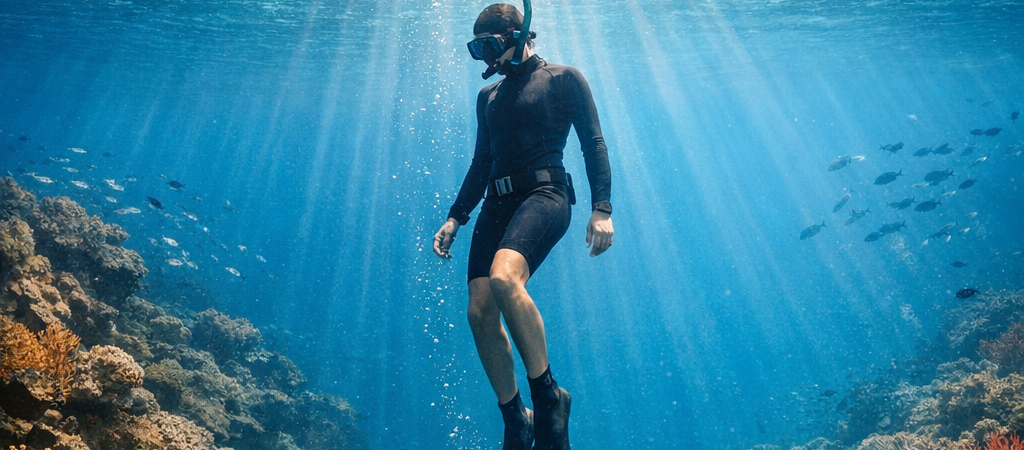
Freediving—the art of exploring underwater on a single breath—is one of the most accessible yet profoundly rewarding water disciplines you can pursue. India, with its extensive coastline, island territories, and growing community of breath-hold diving enthusiasts, offers an ideal setting to learn to freedive. Whether you’re drawn to the coral reefs of the Andaman Islands or the clear waters off Goa and Pondicherry, this guide covers everything you need to know before taking your first plunge into apnea training in India.
7 Steps to Start Freediving in India
- Learn breath control and diaphragmatic breathing
- Practise equalisation (Frenzel technique) in a dry setting
- Take a Level 1 beginner freediving course in India (AIDA, SSI, Molchanovs, or PADI Freediver)
- Buddy up—never freedive alone
- Get your basic gear: low-volume mask, long fins, wetsuit, weight belt
- Train static apnea and dynamic skills in a pool
- Progress to open water at a site suited to your level
Before You Start: Quick Checklist
- You can swim 200 metres continuously and float comfortably for 10 minutes
- You have no unmanaged heart, lung, or ear conditions (consult a doctor if unsure)
- You have identified a trained buddy or enrolled in a course that provides supervision
- You have checked local conditions—visibility, currents, water temperature—at your chosen site
Breath-Hold Basics: Build Your Foundation on Land
Before you ever enter the water, freediving begins with understanding how your body responds to breath-holding. Unlike scuba diving, where you carry your air supply, breath-hold diving relies entirely on your ability to manage oxygen efficiently and remain calm under pressure.
The core skills every beginner must develop include:
Diaphragmatic breathing. Learn to breathe deeply into your belly rather than shallowly into your chest. This maximises oxygen intake before a dive and forms the basis of every static apnea session.
The mammalian dive reflex. When your face contacts cool water, your body naturally slows the heart rate and redirects blood to vital organs. Training helps you lean into this reflex rather than fight it.
Relaxation techniques. Tension burns oxygen. Progressive muscle relaxation and meditation practices directly translate into longer, more comfortable breath-holds. Even five minutes of daily breathwork accelerates your progress.
Start by practising static apnea in a controlled environment—a pool or shallow, calm water—always with a trained buddy present.
Equalisation: Protect Your Ears and Unlock Depth
As you descend, water pressure increases. Learning to equalise the pressure in your ears and sinuses is essential to avoid discomfort or injury—and it’s the skill that determines how comfortably you progress beyond a few metres.
Most beginner freediving courses teach the Frenzel manoeuvre, which uses the tongue as a piston to push air into the middle ear without engaging the chest muscles. Compared with the Valsalva method familiar to scuba divers, Frenzel equalisation is gentler, more efficient, and works at greater depths.
Practice tips:
- Drill the tongue movement dry, on land, multiple times a day
- Equalise early and often during descent—never wait until you feel pressure
- If equalisation fails, stop descending immediately and ascend slightly before trying again
Safety: The Non-Negotiable Priority
Freediving is remarkably safe when practised correctly, but it is unforgiving of complacency. The single most important rule in freediving safety is simple: never freedive alone.
A proper buddy system means your partner watches you throughout every dive, is trained to recognise signs of hypoxia, and knows how to perform a rescue if a blackout occurs. Shallow water blackout—losing consciousness near or at the surface due to low oxygen levels—is the leading cause of freediving fatalities, and it is almost entirely preventable with proper buddy protocols.
Additional safety principles:
- Always dive well-rested and hydrated
- Never hyperventilate before a dive—this masks the urge to breathe without actually increasing oxygen stores
- Progress gradually; depth and time records have no place in early training
- Know your limits and respect them every single session
- Learn rescue techniques during your course and refresh them regularly
Is freediving safe for beginners? Yes—with structured training, a strict buddy system, no hyperventilation, and gradual progression under a certified instructor, the risk is very low.
Essential Gear: Your Freediving Gear List for Indian Waters
One of freediving’s greatest appeals is its simplicity. You don’t need a van full of equipment to get started.
Low-volume mask. Freediving masks sit closer to your face, require less air to equalise, and give you a wider field of vision underwater. Fit is everything—press it to your face without the strap and inhale gently through your nose. If it seals, it fits.
Snorkel. A simple, non-purge snorkel lets you breathe at the surface between dives without lifting your head. Nothing fancy needed.
Long fins for beginners. Long-blade freediving fins provide efficient propulsion with minimal energy expenditure. Beginners can start with plastic-blade fins—affordable and durable—before upgrading to fibreglass or carbon as technique improves.
Wetsuit. Indian waters are warm, but a thin wetsuit (1.5–3 mm) provides thermal protection during extended sessions and guards against jellyfish stings and coral abrasions. Freediving-specific suits offer more stretch and less restriction.
Weight belt. A rubber weight belt with a quick-release buckle helps you achieve neutral or slightly negative buoyancy at depth. Proper weighting is crucial—too much weight is dangerous; too little makes descent exhausting.
Buy quality gear from the outset, but you don’t need to buy everything at once. Most training schools provide equipment during courses, so try before you invest.
Choosing the Right Training Path: Best Freediving Schools in India
Structured training is the safest and most efficient way to learn. When evaluating a beginner freediving course in India, consider the following:
Recognised certification bodies. Look for courses affiliated with AIDA, SSI, Molchanovs, or PADI Freediver India programmes. These bodies maintain standardised curricula, safety protocols, and instructor qualifications. An AIDA course in India or an SSI/Molchanovs/PADI Freediver India certification is recognised worldwide.
Instructor experience. A good instructor should have significant personal diving experience, active teaching credentials, and a clear emphasis on safety over performance. Ask about their background and ongoing training.
Student-to-instructor ratio. Smaller groups mean more personalised attention and safer in-water sessions. Look for a maximum of four students per instructor in open water.
Location. Choose a site with good visibility, calm conditions, and appropriate depth access for your level. India’s top freediving destinations include:
- Freediving in Goa – accessible year-round, established schools, calm sites during October to May
- Freediving in Pondicherry – growing community, warm water, good depth access close to shore
- Freediving in the Andaman Islands and Havelock – exceptional visibility, vibrant marine life, world-class conditions
- Freediving in Karnataka and Netrani Island – clear offshore waters, less crowded, unique marine encounters
Community and ongoing support. The best schools foster a community. Post-certification, having training partners and mentors accelerates your growth and keeps you safe through regular buddy meetups and pool sessions.
How Much Does It Cost? Freediving Course Costs in India
Freediving cost in India varies by agency, location, and what’s included. Expect roughly ₹15,000–₹35,000 for a Level 1 beginner course. This typically covers theory sessions, confined water (pool) training, open water dives, certification fees, and gear rental. Courses in the Andamans may cost slightly more due to logistics, while Goa and Pondicherry options tend to sit in the mid-range.
Budget separately for travel, accommodation, and any gear you decide to purchase after the course.
Where and How Deep Will You Dive?
Most Level 1 courses aim for 10–20 metres of depth, depending on conditions, your comfort, and the certifying agency’s standards. That’s more than enough to experience the quiet beauty of a reef, feel the mammalian dive reflex fully engage, and build confidence for future progression.
The best places to learn—Goa, Pondicherry, Havelock in the Andamans, and Netrani in Karnataka—all offer clear water with reliable depth access within a short boat ride or even from shore.
Frequently Asked Questions
Is freediving safe for beginners?
Freediving is safe with proper training, a strict buddy system, no hyperventilation, and gradual progression under a certified instructor. Most incidents are preventable with correct protocols.
Do I need to be a strong swimmer to learn to freedive?
You should be water-confident. Many courses expect you to complete a 200-metre swim and a 10-minute float before training begins. You don’t need to be a competitive swimmer, but comfort in deep water is essential.
How much does a beginner freediving course cost in India?
Expect roughly ₹15,000–₹35,000 depending on the agency, location, and whether equipment is included. Andaman courses may be at the higher end; Goa and Pondicherry are typically mid-range.
How deep will I dive as a beginner?
Most Level 1 courses aim for 10–20 metres, depending on conditions and your comfort level. Depth comes naturally with practice—there’s no rush.
Where are the best places to learn freediving in India?
Goa, Pondicherry, Havelock Island in the Andamans, and Netrani Island off Karnataka offer clear water, reliable conditions, depth access, and active freediving schools.
What gear do I need to buy before my first course?
Most schools provide all equipment during training. If you want your own, start with a well-fitting low-volume mask and a snorkel. Add long fins, a wetsuit, and a weight belt after the course once you know your preferences.
Take the First Breath
Freediving transforms your relationship with water. It demands patience, self-awareness, and respect for the ocean—qualities that enrich life far beyond the dive itself. India’s warm waters and expanding freediving community make it an exceptional place to begin. Invest in proper training, commit to safe practices, and let curiosity guide you downward, one breath at a time.
Ready to start?
- Download our free beginner gear checklist for Indian waters so you know exactly what to buy and what to skip.
- Compare Level 1 courses in Goa, Pondicherry, and the Andamans and book your first session today.
- Join our India freediving community newsletter for weekly training tips, buddy meetups, and exclusive course discounts.
Where in India are you planning your first dive—Goa, Pondicherry, or Havelock? Drop a comment below and let’s connect you with local training partners.